How far a Christmas projector goes from the house
Set a projector too close and the picture covers one window; set it too far and the lights thin out until the house looks bare. This guide lists the distance each listing gives, shows how coverage grows as you step back, and helps you find the spot on your own lawn.
Why distance matters more than coverage
Every projector box prints a big coverage number, and almost none tell you how far back the projector stood to reach it. That missing distance decides whether your picture fills the front wall, spills onto the roof, or lands as a small bright patch by the door.
The space between the lens and the wall is called the throw distance. Move the projector back and the picture grows; move it closer and the picture shrinks but gets brighter. Every placement choice comes back to that trade.
The distance each listing gives
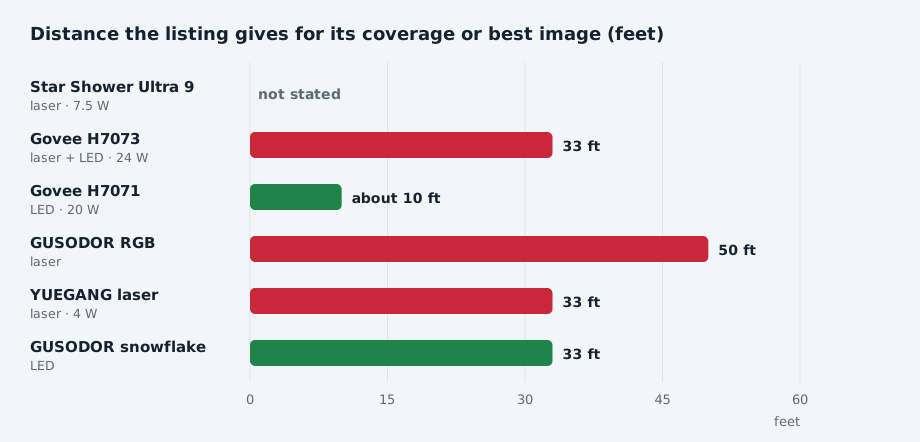
Only some sellers give a distance at all. The chart shows the figure each listing pairs with its coverage claim or calls the best distance, and the Star Shower Ultra 9 has no bar because Amazon gives no distance for it.
| Projector | Type | Distance on the listing | Coverage claimed |
|---|---|---|---|
| Star Shower Ultra 9 | Laser | Not stated | Up to 3,200 sq ft |
| Govee H7073 | LED wash plus laser | 33 ft | 5,069 sq ft at that distance |
| Govee H7071 | LED discs | About 10 ft (Govee’s advice) | Not stated |
| GUSODOR RGB Stars | Laser | 50 ft | About 3,229 sq ft at that distance |
| YUEGANG YG-LA-01 | Laser | 33 ft | Up to 3,800 sq ft from there |
| GUSODOR Double-Head Snowflake | LED | 33 ft (best distance) | 30 to 500 sq ft |
Two patterns stand out. The laser listings quote 33 to 50 ft, while Govee wants its H7071 snowflake projector about 10 ft from the wall. That gap follows from how each kind draws its picture, which our guide to laser or LED projectors explains.
The GUSODOR RGB laser gives the longest figure, about 3,229 sq ft at 50 ft. Few front yards are 50 ft deep, so for most houses that number describes a throw you will never set up.
How coverage grows as you step back
A projector throws a cone of light. The picture’s width grows roughly in step with the distance, so doubling the distance about doubles the width and the height, which makes the area about four times larger.
The light coming out of the lens stays the same, though. Spread over four times the area, each square foot gets roughly a quarter of the light, which is why a picture that looked rich at 15 ft can look thin at 30 ft.
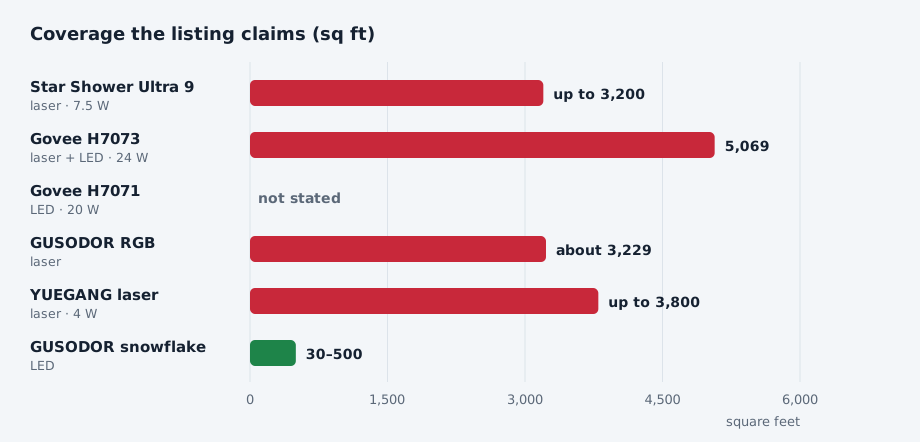
The coverage chart shows what each seller claims, from the 30 to 500 sq ft of the GUSODOR snowflake projector to the 5,069 sq ft Govee gives the H7073. Read those figures as the size of the cone at the listed distance, not as a promise that every square foot looks bright.
You can scale the claims with simple arithmetic. By the square rule, the GUSODOR RGB’s 3,229 sq ft at 50 ft shrinks to roughly 800 sq ft at 25 ft, with about four times the light landing on each square foot.
How big is the front of your house?
Most coverage claims are larger than the wall you want to light. A two-story front 40 ft wide and 20 ft tall is about 800 sq ft, and a single-story ranch 50 ft wide with 10 ft walls is about 500 sq ft.
Anything beyond that lands on the roof, the trees, the lawn or the house next door. Light on low branches can look lovely, but beams over the roofline head for the sky, and that is the one place a laser must never point.
- Measure the wall: width × height in feet, leaving out the roof
- Pick a target: the whole wall, or one section such as the garage and the porch
- Start close: about 15 to 20 ft for a laser, about 10 ft for an LED disc projector
- Walk it back: move the stake a few feet at a time until the pattern reaches the edges, then stop
Do this at night with the porch light off. The picture you see from the sidewalk is the one that counts, so check it from there before you push the stake in for good.
Laser and LED behave differently with distance
A laser projector splits one beam into many points, and each point stays a sharp dot whether the wall is 15 ft or 50 ft away. Distance changes how far apart the dots sit, not how crisp they look.
An LED projector shines through a pattern disc and a lens, so its snowflakes and stars are images that grow softer and dimmer as you back away. Owners of the H7071 describe it as bright up close, with figures that blur farther from the house.
That makes LED projectors happiest close to a light, plain wall, and lasers the better fit for a deep front yard. If your picture looks weak at any distance, our guide on why a projector looks dim covers the fixes beyond moving closer.
When the yard is too short or too deep
A shallow yard limits the picture size. A projector 8 ft from the wall lights only a small patch, so you can aim two units at different parts of the house, or treat one projector as an accent for the porch and the door.
A deep yard tempts you to push the projector out to the curb. Keep it on your own land and away from where people walk, and remember that the farther back it sits, the thinner the light on each square foot.
Our seven placement tips cover stakes, angles and the roofline in more detail. Some houses suit neither setup, and a long, low front or a house set far behind trees may look better outlined with string lights, which our comparison of projectors and string lights weighs up.
Picking a projector by distance
If you can stand back 30 ft or more, any of the lasers will spread wide enough, and the full specs sit side by side in the comparison table.
If the projector has to live close to the wall, an LED disc model such as the Govee H7071 (see its card) gives you shapes that hold up at short range.
Still unsure which kind suits your house? The laser or LED section on our homepage and our pick of the best Christmas light projector both start from the same question of where it will stand.
For a front yard about 30 ft deep
Govee rates the Aurora Star H7073 at 5,069 sq ft from 33 ft, one of the few listings that names a distance with its coverage, with an LED wash and laser stars. It sits at the top of the $ band, so a cheap laser suits you better if you only want dots.